Education
Health and Wellness
Business and Government
General
Student Life
Arts and Humanities
Culture and Society
General
Student Life
WFMA’s Printing the American Revolution exhibit featured by BBC
A collaboration between Midwestern State University students, faculty, and the Wichita Falls Museum of Art not only created a unique hands-on learning experience but also attracted international attention, earning a prominent mention in a BBC story about the American Revolution.
The Wichita Falls Museum of Art and Midwestern State University are not institutions typically featured by the British Broadcasting Corporation. Yet both were highlighted because of an exhibition centered on prints from the American Revolution, a project that combined academic research, museum expertise, and student involvement.
In the Fall of 2025, as Matthew Bailey, the new Director of the WFMA, was just beginning his work, a plan was already in place to add an exhibition focused on the prints of the American Revolution. This exhibition was brought to fruition by Mary Draper, Ph.D., who is a professor of history at MSU Texas. While a tremendous amount of work and consideration went into the exhibition, it proved worthwhile when it drew the attention of the BBC (British Broadcasting Corporation).
Draper reached out to BriAnna Satterfield, the museum’s collections manager, in May of 2025 with the hopes of putting together an exhibition to honor the 250th anniversary of the United States using items from the museum and the Special Collections branch of Moffett Library. The exhibit is open until August 22, 2026.
"These are the images that you read about in middle school and high school, and here they are, just a hundred feet away," Draper said.
Draper designed the project as part of her Revolutionary America course. While the first half of the semester followed a traditional classroom format, the second half focused on developing the exhibition. Draper and Bailey combined their expertise throughout the process, with Draper contributing historical analysis and Bailey applying his background in visual interpretation and exhibition design.
Students played a central role in selecting artifacts for display. Many had the rare opportunity to handle centuries-old documents and prints firsthand. After choosing an item that interested them, each student researched the piece and wrote an essay, which was later condensed into exhibition text for visitors.
Draper wanted to provide her Revolutionary America class with a more hands-on learning opportunity through direct work with artifacts that reflected what they’d be learning in class. The first part of the semester was like an ordinary class, but the second half was focused on the exhibition as Draper and Bailey teamed up to bring together their strengths to make the plan for the exhibition a reality. While Draper was well-versed in the history of the period, her knowledge mostly came from analyzing texts, whereas Bailey’s specialty is analyzing images.
Draper said students were part of the process in selecting pieces that would be added to the exhibition. Getting to delicately handle the centuries-old items was an experience the students likely won’t forget, as it’s one thing to learn about an artifact and another to get to handle it. From there, the students were to pick an item that stood out to them and write a research essay about it. That essay was then condensed into an exhibition label for that piece. Draper and Bailey were then able to map out how the exhibition should be organized, while Bailey filled in gaps with additional pieces.
“They did a fantastic job — object labels are an art form in themselves. I just provided some strategies and advice, and the students did the rest,” Bailey said. “Mary wrote the main exhibition text and the text on the Paul Revere print, while I wrote the text on revolutionary portraiture. Editing those was a collaborative process, with the exhibition design and installation involving myself and BriAnna.”
For Draper, seeing the completed exhibition was especially rewarding.
“To see all my students’ work carefully and professionally displayed — it was like a vision realized,” Draper said. “Even though I
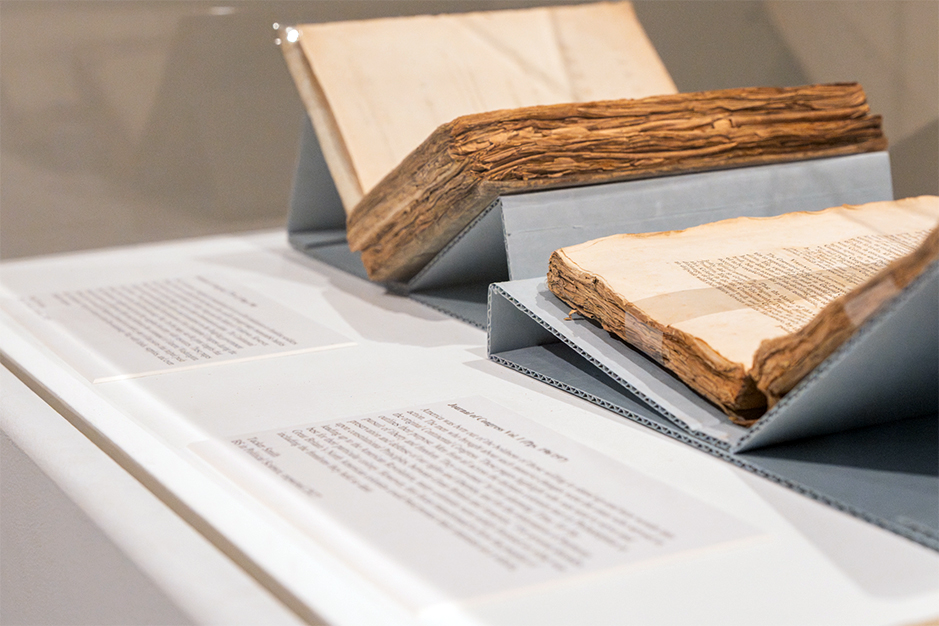
told my students that they’d be writing exhibit copy, many of them did not know that their exhibit copies would be in the exhibit. It was so great because it was this moment where they saw all their hard work hanging there.”
Beyond showcasing historical artifacts, the exhibition was designed to encourage visitors to think critically about the American Revolution and the ways it has been remembered and represented.
Draper said the goal was to move beyond a simple retelling of dates and events by highlighting multiple perspectives and lesser-known stories from the period.
“We wanted to demonstrate how there was no one unified perspective or opinion on the revolution or the nature of democracy, nationhood, and independence. And also, that the images of the so-called ‘founding fathers’ reflect mythological idealizations of them, constructed images and narratives that say more about their creators and cultural ideas than the realities of the figures themselves,” Bailey said.
Soon after opening, the exhibition began attracting attention from both the local community and visitors interested in its unique collection. What organizers did not anticipate was international recognition.
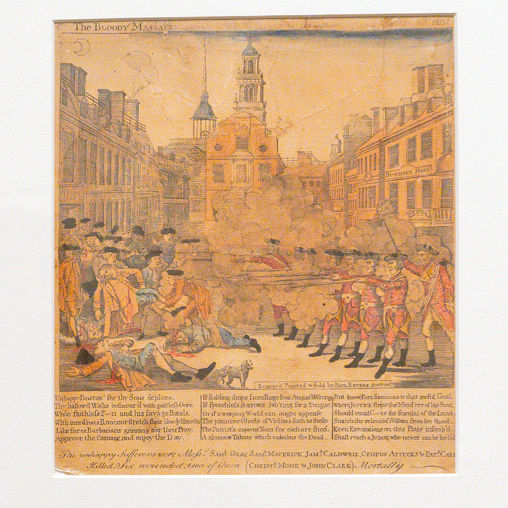
One of the exhibition's standout pieces is the museum's copy of Paul Revere's The Bloody Massacre Perpetrated in King Street, Boston, on March 5, 1770. Draper believes fewer than 30 copies exist worldwide. Its rarity caught the attention of a BBC journalist working on a story about the American Revolution, prompting a visit to Wichita Falls.
According to Draper, Todd Giles, Ph.D., professor of English at MSU Texas, had previously discussed the print on a podcast. That mention eventually helped bring the artifact to the BBC's attention. The journalist later connected with Draper, who provided background information about the exhibition and its collection.
When the article was published, the Wichita Falls Museum of Art and its holdings played a significant role in the story.
The recognition highlighted not only the extensive work behind the exhibition but also the scholarly and cultural resources available at MSU Texas and the Wichita Falls Museum of Art.
Bailey said he felt "surprised, humbled and honored" by the museum's prominent inclusion in the BBC coverage.
The exhibition was Bailey's second collaboration with MSU Texas faculty, and he hopes it will be one of many. One of his primary goals since arriving at the museum has been strengthening partnerships across the university.
Bailey views these efforts as teaching exhibitions and believes they provide value to students, faculty, the museum, and the broader community.
“I learned how enjoyable the collaborative process can be in curating and how important it is to collaboration to provide different perspectives and ways of thinking about the objects in question and the exhibition as a whole,” Bailey said. “In the future, I look forward to collaborating with students more closely with their research and in the exhibition-making process. This will provide opportunities for students to think differently about their research, no matter the subject, as well as learn about museum practice.”
Those collaborations are already continuing. Bailey said the museum's next jointly curated exhibition will open in early September and will feature cameras from the WFMA permanent collection. The exhibition will be co-curated by Bailey, Lamar D. Fain College of Fine Arts Dean Leah Gose, and photography professor Ashley Gillanders. It will coincide with an exhibition of photographs by Brett Weston, of which the trio will also be co-curators.
Through projects like these, Bailey hopes to expand opportunities for collaboration while reinforcing the museum's role as a learning laboratory for students and a cultural resource for the community.
Related Posts
Health and Wellness
General
Science and Technology
Student Life
Faculty support, campus involvement make the difference
General
Education
Policy and Law
Health and Wellness
Colleges name faculty award recipients
Health and Wellness
General
Education