Health and Wellness
General
Student Life
General
Arts and Humanities
Student Life
Agar Art competition at MSU Texas displays value of creativity
Midwestern State University recently held its annual Undergraduate Research and Creative Activity Forum on campus.
The annual event allows undergraduate students an opportunity to showcase the research they’ve done throughout the year, and often through creative methods. One example of this is the Agar Art Competition, hosted by Tri-Beta.
Diamond Gamboa, the President of Tri-Beta, explained that the competition involves participants using a particular medium and combining it with different bacteria to achieve different colors. Some examples of the mediums used included Tryptic Soy Agar, Eosin Methylene Blue, and MacConkey. The available bacteria were E. coli, M. luteus, K. rosea, E.aerogenes, C.freundii, S.marcescens, and S.epidermidis. Participants were able to pick a medium and use a graph to navigate the response of each bacterium with that medium to determine color choices.
Gamboa said the previous president of Tri-Beta came up with the idea for the competition after doing a similar activity at a conference. Gamboa said they partnered to make it happen at MSU, with the help of the Wichita Falls Museum of Art. The first one took place in Spring 2025.
"We ran it, and it was a really great outcome, so we decided we wanna make this an annual event," Gamboa said. "I give her full credit for coming up with the idea, and our members keep this little tradition that we wanna keep doing alive."
Gamboa said that the competition portion comes after the actual event, so everyone has the comfort to create art without pressure and learn something about bacteria in the process. After the event, members of Tri-Beta post photos of the completed art, and viewers will have several days to vote on which piece is the best. And the winner will receive an Amazon gift card.
Trinity Munoz is a nursing student
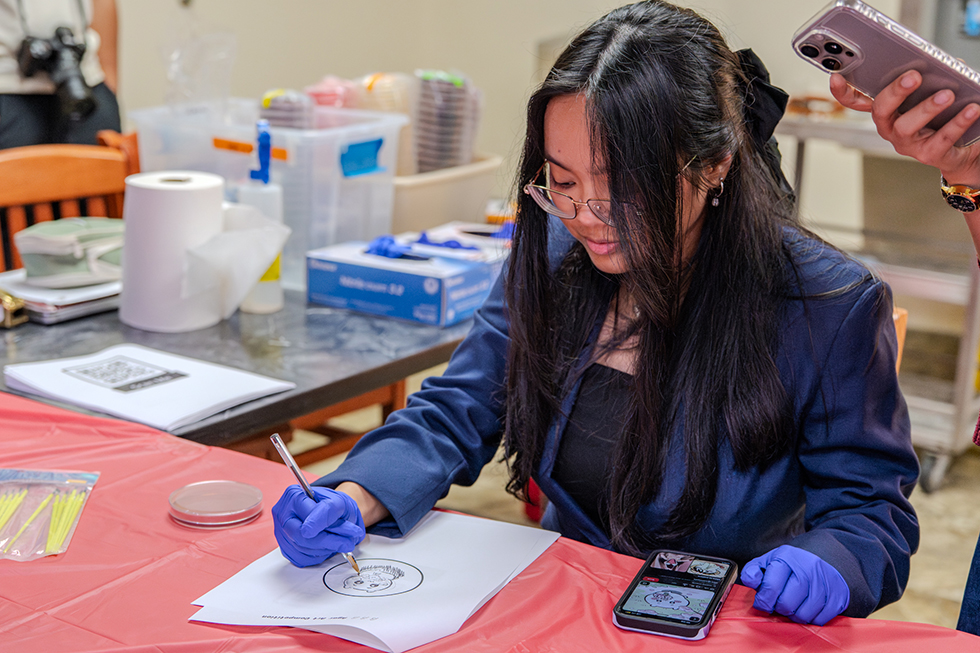
who participated in the forum. She said she was encouraged by her mentor to pursue research on reactions to different drugs. She decided to participate in the Agar Art Competition to support her friends in Tri-Beta, and to broaden her understanding of reactions across different fields – in this case, about bacteria. She was more interested in the experience than the art and “just wanted to create something cute.”
“I love how we’re able to have these undergraduate students express their interests outside of the classroom,” Munoz said. “Really, it helps you just question the world around you – especially in the science field or the healthcare field.”
Through the experience, Munoz said her perspective of bacteria changed. While in her field, the focus on bacteria is often negative and is something that must be treated, she said the Agar art competition showed her that bacteria can have other purposes.
Despite being run by a biology program, the competition demonstrates the true potential of finding a creative outlet through any lens. Gamboa said that while the competition doesn’t benefit Tri-Beta directly, she believes it promotes science and helps people realize that it can be fun. She believes the greatest benefit of the event is that it demonstrates that no one has to be primarily right-brained or left-brained, but that people can engage with both by getting creative within the fields they’re passionate about.
“We don’t want them to think that just because they’re not a science major, they can’t do science activities – it connects to everybody,” Gamboa said.
Related Posts
Culture and Society
Health and Wellness
Science and Technology
General
Student Life
A look at plant life at Midwestern State University

Health and Wellness
Sports
Student Life
General
Emma Kasza-James wins Gravel Nationals

Student Life
General
Health and Wellness