Health and Wellness
General
Student Life
Culture and Society
Health and Wellness
Science and Technology
General
Student Life
Greenhouses enhance campus beauty, education at MSU Texas
One can find vibrant flowers, native grasses, and shady trees all across the Midwestern State University campus. MSU Texas was voted the most beautiful campus in Texas, and it makes sense that many native plants growing on the grounds reflect the beauty of the state as a whole.
Many of these plants were even grown on campus, started from seed in the Dr. Arthur F. Beyer Greenhouse, located near Sikes Lake. There are two greenhouses on campus, with the other being the Bolin Greenhouse, used by the biology department. The Beyer Greenhouse contributes to campus beauty, while the Bolin Greenhouse provides a hands-on education for students. They produce beautiful and unique plant life and provide equally valuable knowledge.
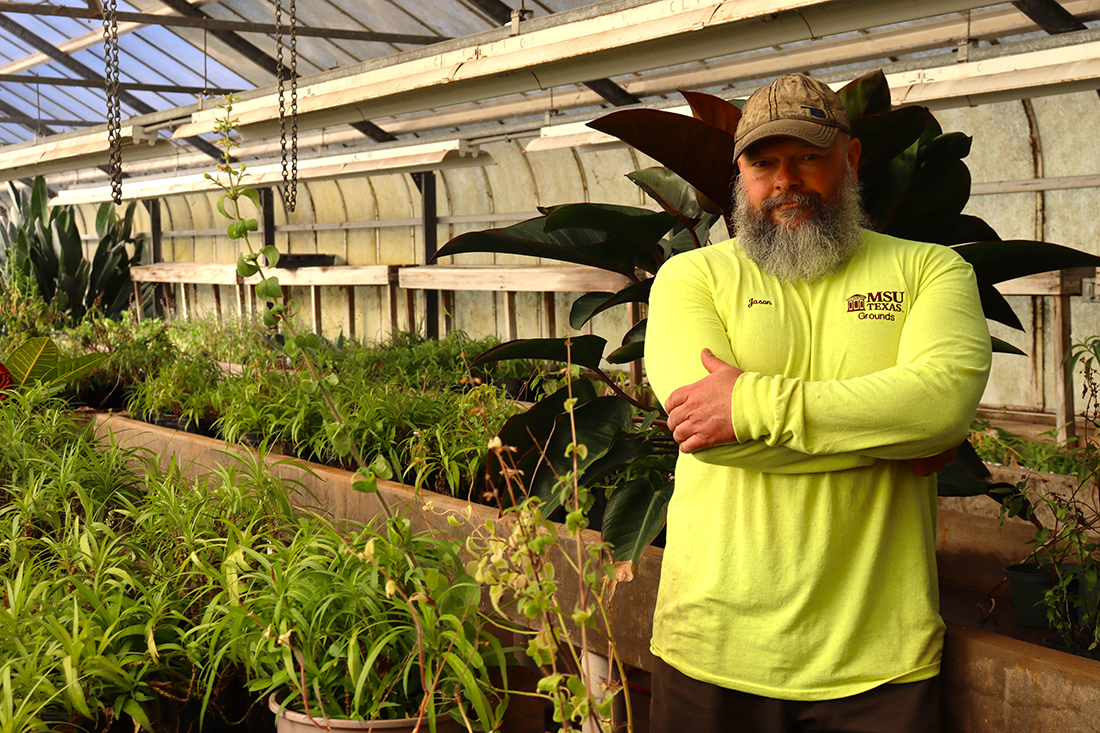
Jason Cooper, the Grounds Maintenance Superintendent of MSU, said one of the things he enjoys most about his job and working in the greenhouse is that it continually provides him with an outlet for further education on plants. Cooper has worked as a groundskeeper for MSU for 22 years. Over that time, Cooper has been able to experiment with lighting, soil, and the impact of climate conditions on the plants at the greenhouse. He noted this allows him to understand which plants will grow best in different areas of campus.
“The work is a teacher. I’m super fortunate,” Cooper said. “It has given me the opportunity to discover my passion with plant material and changing landscapes more with an eco-emphasis, habitat remediation, native plants, and all the support that I understand to be vital to improving life experience as we know it.”
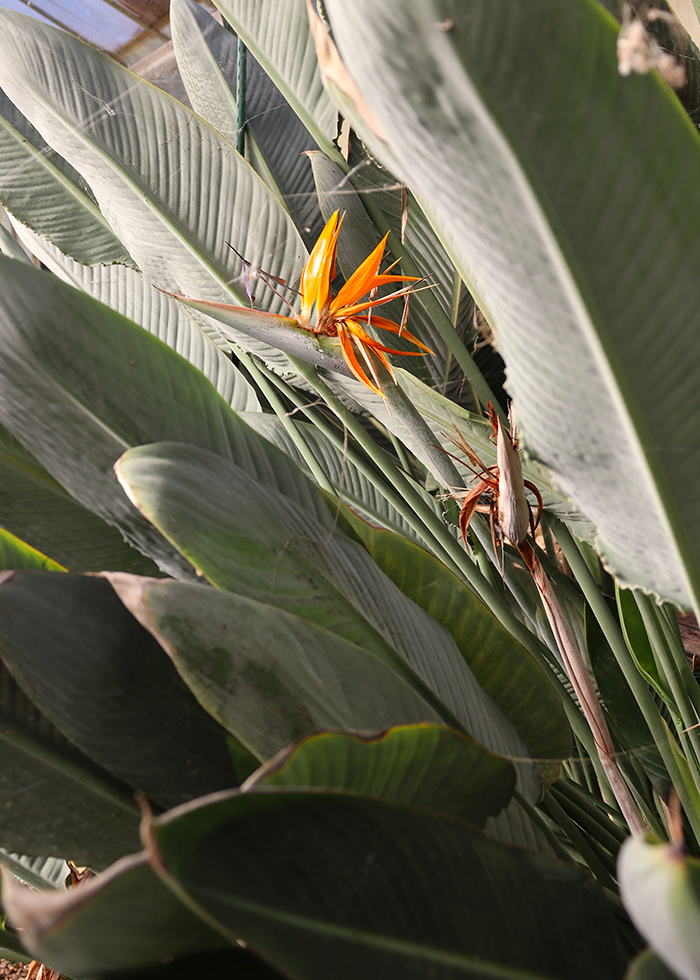
The Beyer Greenhouse, built in the 1980s, hosts mostly native plants. It holds a range of herbs, flowers, succulents, vegetable plants, and trees. Cooper has recently increased his efforts to incorporate native species around campus with an emphasis on pollinator-friendly plants. He believes that incorporating native plants on campus benefits the mental well-being of students and helps sustain the local environment.
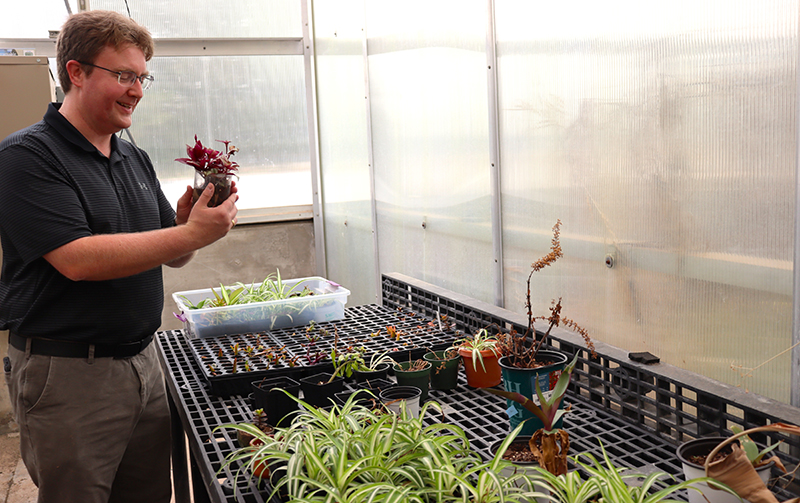
Timothy Pegg, an assistant professor of biology at MSU Texas, oversees the Bolin Greenhouse, which was erected in the 90s to provide a more convenient location for students to study plants. He said students are responsible for much of the upkeep of plants.
Current renovations at the greenhouse are to improve the climate control and expand the variety of plant life grown there, Pegg said. He believes providing a versatile greenhouse that students must maintain is a necessary part of the learning process, as it gives students “practical experience.” He believes working with plants hands-on instills patience and better responsibility. Students can hold a plant sale each semester to show off and benefit from their hard work. These sales usually happen around finals time.
“Plants grow slowly, so you need to tend to them, you need to watch them, you need to nourish their development for growth,” Pegg said. “Patience is a valuable skill. It helps not just in botany, but in anything you do – be it construction or making a PowerPoint.”
Students also have opportunities to get involved at Beyer Greenhouse, Cooper said. A community garden growing near the Wellness Center is partially student-managed. He said produce is even harvested from it and donated to the Campus Food Pantry.
Some student organizations are involved in keeping up some of the flower beds around campus. He said he is always looking for more volunteers to help out.
“I’ve learned about these systems, done the research, and then through trial and error and support from the campus and administration, and using communication and vision, I’ve been able to bring about changes and continue to move in a direction that can only edify the environment which edifies the living experience for students, faculty, and staff,” Cooper said.
Some plants thrive even amidst severe temperatures in North Texas, while other plants can be moved inside with the greenhouses open throughout the year. Cooper and Pegg said this discovery, which ones can acclimate, is often accomplished through trial-and-error observations.
The North Texas environment can be difficult to grow in, and even if a plant does well under certain conditions in the greenhouses, there’s no guarantee it will do as well outdoors. They both mentioned that soil is a vital factor in a plant’s success outdoors. The soil in this area is dense in clay, making it unsuitable for a wide variety of plants and requiring testing and remediation to produce successful growth.
“I’d say the largest part of what I do here, especially through the teaching collection, is of an informative, educational nature — so getting people to think about plants, to care about their influence on the world around them. Not all plants grow equally well in different environments. You have to think about what you want to grow and work around the climate and conditions,” Pegg said.
While having a garden is a great way to benefit the local environment and one’s own health, not everyone has the resources and housing situation to grow a full-scale garden or have a greenhouse. Fortunately, Cooper and Pegg said there are many ways to get around these concerns. Cooper suggested growing a garden in pots on a porch or even in a windowsill to be considerate of space. He also mentioned a few local resources and groups, such as the Texas Master Naturalist, the Texas A&M AgriLife Extension, and a couple of local nurseries. For those growing on a budget, Pegg suggested visiting local plant stores and nurseries and asking if they have any leftover supplies or ailing plants they may be willing to give away. He said that often, palettes used to make raised beds and disposable pots can be obtained this way.
“As people interact with the plants more, they learn more. Native plants have always been around. With media coverage over the last few years about climate change and global decline in insect populations, people are interested in what they can do in their own yards or even in containers to help,” Cooper said.
Related Posts

Health and Wellness
Sports
Student Life
General
Emma Kasza-James wins Gravel Nationals

Student Life
General
Health and Wellness
Prioritizing student health

General
Health and Wellness
Student Life